


OpenClaw AI Automation: Automating WordPress Plugin and Theme Update Management with AI Agents (Part 67)
April 18, 2026
OpenClaw AI Automation: Advanced AI-Driven Automated WordPress Multisite Management and Optimization (Part 69)
April 19, 2026Introduction
Building on prior explorations of OpenClaw AI automation for WordPress management, this installment delves into automating custom WordPress plugin development and deployment workflows. For business owners and technical operators, efficiently managing plugin lifecycles can be complex and time-consuming. Leveraging OpenClaw AI agents to automate these workflows reduces human error, accelerates delivery, and enhances maintainability.
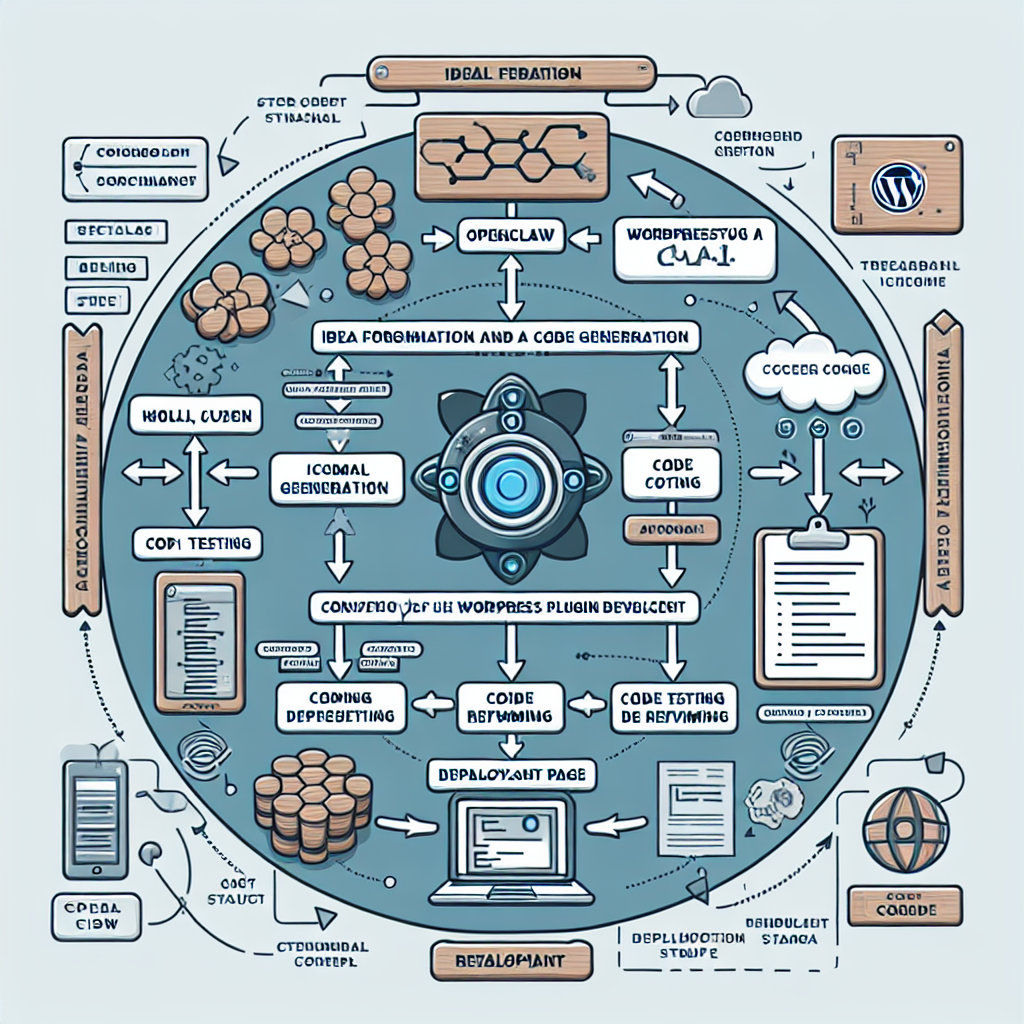
We will cover techniques to automate plugin scaffolding, code generation, testing, version control integration, deployment, and monitoring using OpenClaw’s AI orchestration capabilities. Practical examples will illustrate how to incorporate intelligent automation from development through live site updates.
Why Automate Custom Plugin Development with OpenClaw AI?

Custom plugins provide tailored functionality essential to many WordPress websites. However, manual development and deployment introduce risks:
- Inconsistencies: Human errors in code or deployment steps can cause site issues.
- Time inefficiency: Repetitive tasks slow down feature delivery.
- Poor version control: Without disciplined processes, code changes can be lost or overwritten.
- Testing gaps: Manual testing is often incomplete, leading to bugs in production.
OpenClaw AI agents automate these workflows intelligently, ensuring repeatable quality and freeing developer time for creative problem-solving. AI agents can interpret requirements, generate code templates, validate functionality, and coordinate deployment via CI/CD pipelines.
Automated Plugin Scaffolding and Code Generation
Step 1: Dynamic Plugin Boilerplate Creation
OpenClaw AI agents can generate plugin scaffolds based on project specifications. For example, a business owner requests a “custom contact form plugin with conditional fields.” The AI agent parses this requirement, selects appropriate WordPress hooks and APIs, and builds a structured plugin folder with:
- Standard files:
plugin-name.php,readme.txt,uninstall.php - PHP class skeletons for modularity
- Basic admin UI and shortcode registration code
- Security best practices like nonce verification
This initial boilerplate saves hours of setup and ensures adherence to WordPress coding standards.
Step 2: Intelligent Code Expansion
After scaffolding, OpenClaw AI agents can incrementally add features. For example, integrating AJAX submission handling or custom database tables. By analyzing existing plugin code and leveraging training on WordPress APIs, the AI proposes code snippets that developers can review and approve.
Example: To add email notification on form submission, the AI generates the wp_mail() integration with customizable templates.
Integrating Automated Testing and Quality Assurance
Unit and Integration Tests Generation
OpenClaw AI can create PHPUnit test cases tailored to the plugin’s functionality. Tests cover:
- Function outputs and return values
- Shortcode rendering correctness
- Database CRUD operations
- Security checks such as input sanitization
These tests run automatically in CI pipelines triggered by code commits.
Static Code Analysis and Security Audits
AI agents integrate with tools like PHP_CodeSniffer and WordPress VIP coding standards to scan plugin code for:
- Syntax errors
- Deprecated functions
- Security vulnerabilities (e.g., SQL injection risks)
OpenClaw can further suggest fixes or improvements based on detected issues.
Automated Version Control and Branch Management
OpenClaw AI agents seamlessly connect with Git repositories (GitHub, GitLab). When a plugin scaffold is generated or updated:
- An AI agent creates feature branches automatically
- Commits changes with meaningful messages generated from code diffs
- Opens pull requests for human review
- Manages branch merges and resolves simple conflicts autonomously
This automation maintains clean version history and accelerates collaboration.
Continuous Integration and Deployment Pipelines
CI Pipeline Automation
On pull request submission, OpenClaw triggers automated workflows:
- Runs unit and integration tests
- Performs static analysis and security linting
- Generates code coverage reports
Failures prompt AI agents to notify developers with actionable feedback.
Safe Deployment to Staging and Production
Once tests pass, OpenClaw AI orchestrates deployment:
- Deploys plugin updates to a staging WordPress environment for manual QA
- Runs compatibility checks with existing themes and plugins
- Upon approval, promotes updates to production
- Monitors plugin health and rollback triggers if errors arise
This robust deployment reduces downtime risks and ensures consistent user experience.
Real-World Implementation Example
Consider a digital agency using OpenClaw AI automation to build and deploy a custom booking plugin for multiple client sites:
- The agency inputs client requirements into an OpenClaw prompt describing desired features.
- AI generates plugin scaffolding and code snippets for appointment management.
- The agency developers review and extend the code with AI-suggested features.
- OpenClaw creates tests and integrates them into CI pipelines on GitHub.
- Upon commit, AI agents run tests and static analysis, automatically creating pull requests.
- After QA approval on staging, AI deploys the plugin update to each client’s WordPress site.
- OpenClaw monitors plugin operation, alerting the agency on anomalies for proactive fixes.
This workflow cuts development time by over 40% and improves plugin stability across client environments.
Best Practices for Leveraging OpenClaw AI Automation in Plugin Development
- Define clear plugin requirements: The quality of AI-generated code depends on precise input prompts.
- Use incremental automation: Combine AI-generated boilerplate with expert developer review.
- Implement comprehensive testing: Automate tests early to catch issues fast.
- Automate version control rigorously: Maintain disciplined branching and commit practices.
- Monitor deployments actively: Use AI agents to watch for plugin conflicts or errors post-deployment.
Conclusion
OpenClaw AI automation elevates custom WordPress plugin development and deployment by automating repetitive tasks, enforcing quality, and speeding delivery. Business owners and technical operators benefit from a streamlined, reliable plugin lifecycle that reduces errors and frees valuable developer resources.
Implementing these advanced AI-driven workflows requires initial setup and training but yields significant long-term productivity gains. Future installments will explore extending OpenClaw automation to multi-plugin orchestration and cross-site management.