


OpenClaw AI Automation: Implementing AI-Driven Automated WordPress User Behavior Analytics and Personalized Marketing Workflows (Part 59)
April 13, 2026
OpenClaw AI Automation: Integrating AI-Driven Automated WordPress Multilingual Content Management Workflows (Part 61)
April 14, 2026Introduction
Welcome to Part 60 of our comprehensive OpenClaw AI Automation series. After covering a wide range of topics from plugin conflict detection to personalized marketing workflows, this installment focuses on how to implement AI-driven automated content generation and SEO optimization workflows tailored for WordPress websites. Leveraging OpenClaw AI agents, business owners and technical operators can now automate the tedious and time-consuming aspects of content creation, keyword research, and SEO improvements — all critical to growing organic traffic effectively.
Why Automate WordPress Content Generation and SEO with OpenClaw?

Quality content combined with solid SEO is the backbone of a successful WordPress site. However, manually researching keywords, generating optimized content, and updating SEO tags can be overwhelming for small business owners or agencies managing multiple clients. OpenClaw AI automation offers a scalable solution by orchestrating multiple AI agents that collaborate seamlessly to produce optimized content and apply SEO best practices automatically.
Benefits of AI-Driven Content and SEO Automation
- Consistency: Ensure regular, high-quality content output without manual delays.
- Efficiency: Reduce human workload by automating keyword research, drafting, and SEO tagging.
- Optimization: Use AI to analyze SEO trends and apply data-driven keyword strategies.
- Scalability: Manage multiple sites and content pipelines via automated workflows.
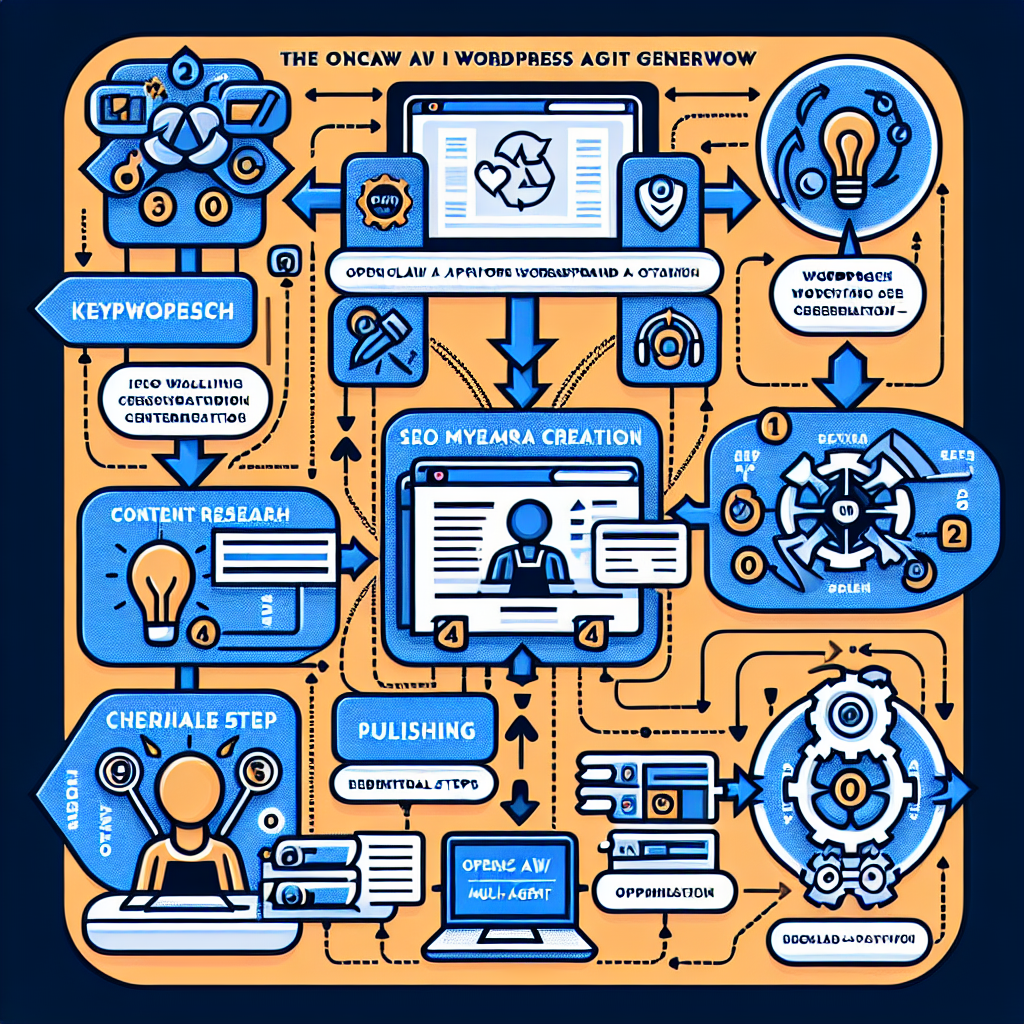
Architecting OpenClaw AI Content Generation and SEO Workflows
Let’s break down a practical implementation to automate WordPress content generation and SEO optimization using OpenClaw AI agents.
Step 1: Keyword Research Agent
This agent continuously monitors relevant keyword trends using integrated SEO APIs (e.g., Ahrefs, SEMrush) or open data sources. It generates a prioritized keyword list based on search volume, competition, and relevance to your niche.
Example prompt:
"Identify top 10 high-volume, low-competition keywords for 'organic skincare' targeting US market this week."
The agent saves keyword data to a shared repository accessible by other agents.
Step 2: Content Drafting Agent
Using the keyword list, this agent creates detailed blog post drafts, incorporating SEO best practices such as keyword placement, meta descriptions, headings structure, and readability. It leverages OpenAI’s language models tuned for content marketing.
Example prompt:
"Generate a 1500-word blog post draft on 'Top 5 organic skincare routines' targeting keyword 'organic skincare routines' with engaging and informative tone."
The draft includes internal links, alt text for images, and schema markup suggestions.
Step 3: SEO Metadata Optimization Agent
This agent reviews the drafted content and generates optimized SEO metadata, including meta titles, meta descriptions, and focus keywords. It also suggests URL slugs and schema.org markup for enhanced search results.
Example prompt:
"Analyze this blog post draft and provide an SEO-optimized meta title, meta description, and recommended URL slug."
Step 4: WordPress Integration Agent
Using WordPress REST API or WP-CLI, this agent automates the publishing workflow:
- Creates a new post draft with the AI-generated content.
- Applies SEO metadata and tags.
- Schedules publishing or publishes immediately based on workflow rules.
- Uploads inline images with alt text as suggested.
Detailed Workflow Example
Here’s how these agents work together in a real-world scenario:
- Keyword Research Agent runs weekly, updating keyword priorities.
- Content Drafting Agent pulls the top keyword, generates a quality draft, and stores it.
- SEO Metadata Optimization Agent processes the draft, creating metadata.
- WordPress Integration Agent creates a post in WordPress, uploads images, and schedules it.
- Monitoring Agent tracks post performance and feeds data back to improve keyword research.
Implementing the Workflow with Code Snippets
Example: Triggering Keyword Research Agent
const openclaw = require('openclaw-ai');

async function runKeywordResearch() {
  const prompt = "Identify top 10 high-volume, low-competition keywords for 'organic skincare' targeting US market this week.";
  const keywords = await openclaw.generate(prompt);
  // Save keywords to database or shared repo
  console.log('Keywords:', keywords);
}

runKeywordResearch();
Example: Publishing Content to WordPress via REST API
const axios = require('axios');

async function publishPost(title, content, meta) {
  const postData = {
    title: title,
    content: content,
    status: 'publish',
    meta: {
      seo_title: meta.title,
      seo_description: meta.description,
    }
  };

  const response = await axios.post('https://yourwordpresssite.com/wp-json/wp/v2/posts', postData, {
    headers: {
      'Authorization': 'Bearer YOUR_API_TOKEN'
    }
  });
  return response.data;
}
Best Practices for Content Quality and SEO
- Human Review: Even with AI automation, schedule periodic human audits for quality assurance.
- Custom Templates: Configure AI prompts with brand voice and style guidelines to maintain consistency.
- Image Optimization: Automate image compression and alt text generation to improve load times and accessibility.
- Link Management: Use automated internal linking to boost SEO and user engagement.
- Performance Tracking: Integrate Google Analytics and Search Console data to refine AI keyword targeting.
Case Study: Automating a Niche Blog Content Pipeline
A small digital agency implemented this OpenClaw AI content and SEO workflow for a client specializing in eco-friendly products. Weekly, the system generated 3 blog posts optimized for trending keywords. The agency reported a 40% increase in organic traffic within 3 months and reduced manual content creation time by 70%.
Common Challenges and How to Overcome Them
Challenge: AI Content Quality Variability
Solution: Use prompt engineering and iterative training with custom datasets to refine output quality.
Challenge: SEO Algorithm Changes
Solution: Incorporate adaptive AI agents that monitor SEO news feeds and adjust keyword priorities dynamically.
Challenge: Integration Complexity
Solution: Leverage modular OpenClaw agents with clear API contracts and error handling to simplify maintenance.
Extending the Workflow: Multilingual Content Generation
OpenClaw agents can be extended to generate multilingual content by incorporating translation APIs and localized keyword research, enabling global SEO strategies without multiplying manual effort.
Conclusion
Automating WordPress content generation and SEO optimization with OpenClaw AI agents offers a powerful way for businesses to maintain competitive online visibility with minimal manual effort. By architecting multi-agent workflows that handle keyword research, content drafting, SEO optimization, and publishing, you can build a scalable, data-driven content pipeline that evolves with market trends.
In the next part of our series, we will explore AI-driven automated WordPress multilingual content management and global SEO strategies.